
Content work is judged by people who cannot see it
For twenty years the value of content has been discussed through a marketing lens—traffic, clicks, campaign attribution. Product content never fitted that frame. So when the roadmap tightens, the sentence that decides whether someone completes a task or abandons it is the first thing cut, because nobody in the room can say what it is worth.
Content ROI models were built for published, campaign-shaped content. A permissions screen has no funnel and no attribution window.
Most practitioners have no reason-coded support data and no cost per contact. Being asked to price the work is being asked to lose the argument.
The same evidence has to be spoken one way to engineering and another to the business. Most of us translate on the spot, badly.
It gives the argument a shape, and shows where the shape came from
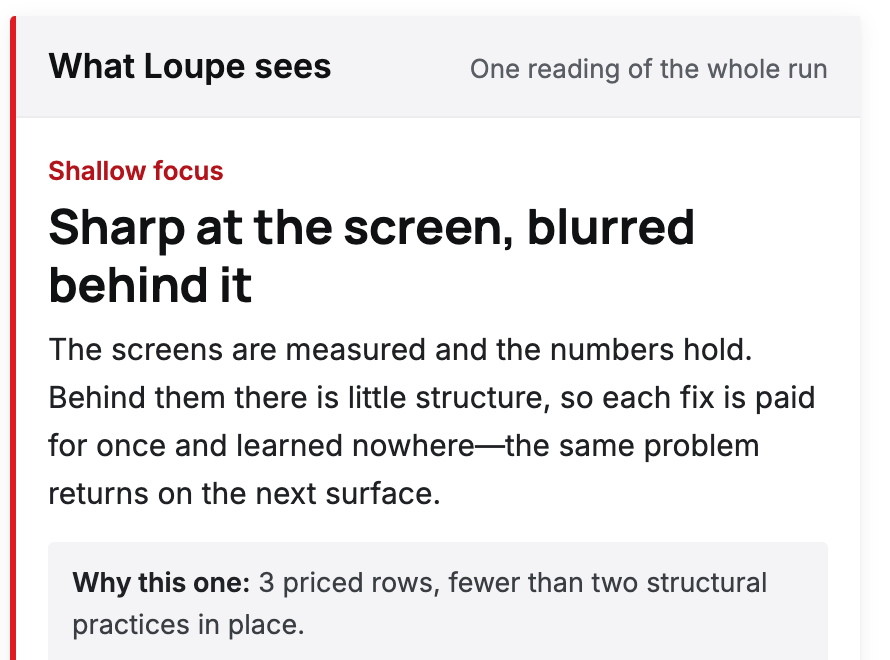
Answer a set of questions about one product and the screens inside it. Loupe assembles a scorecard as you go, pricing what your own figures support and reading the rest from symptoms you can observe. It never prices what it cannot defend.
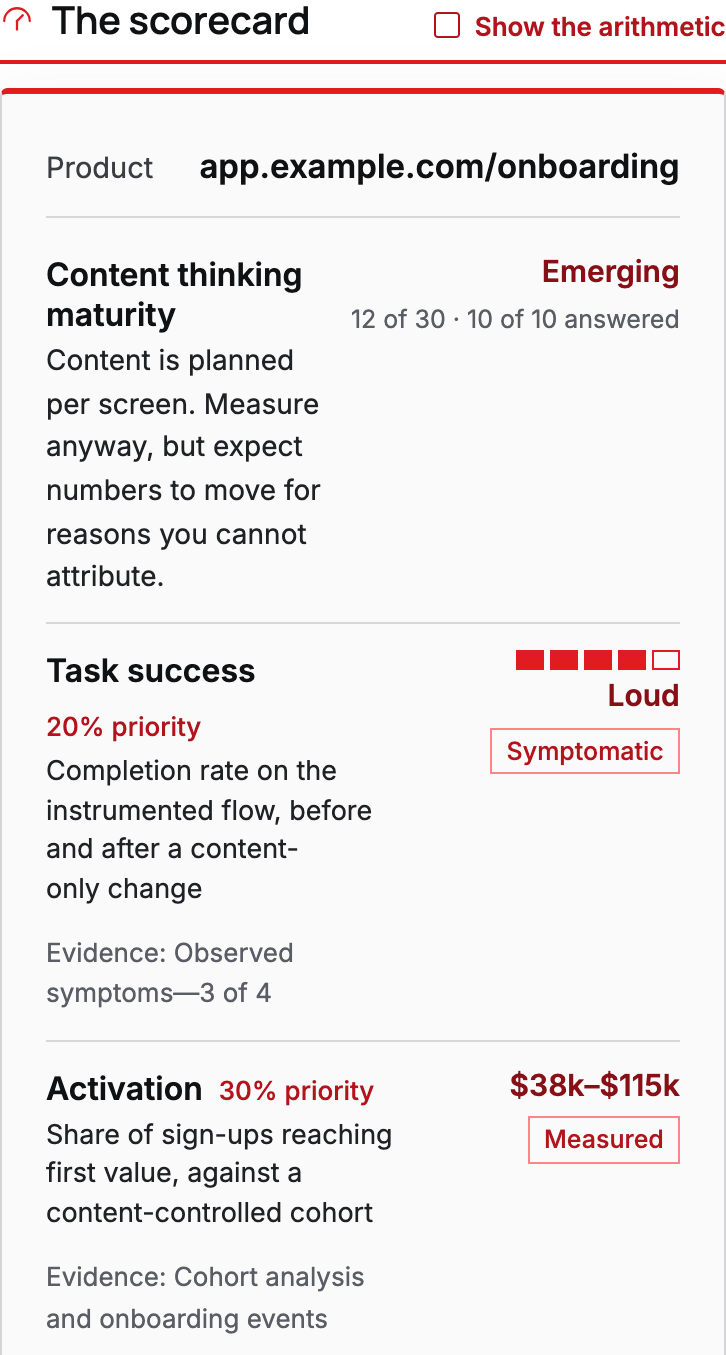
Measured, corroborated, symptomatic or argued. Rows you have not answered stay grey rather than being guessed for you.
The coefficients Loupe supplies are marked as its own, and you can change any of them to the share you actually know.
The same evidence rewritten for product, design, engineering, support, research and the business, so you never translate on the spot.
Four moves, in this order, for a reason
The sequence matters more than any single answer. Each step narrows what the next one can honestly ask you, which is why the tool refuses to open with a calculator.
A URL, or the screenshots you already have. Then name the screens you actually want judged.
Why: a scorecard for a whole product is unusable. One named screen can be instrumented and defended.
Ecosystem maps, content models, taxonomy, journeys, audits—which of these are real where you work.
Why: a team that cannot describe its content will keep paying the same costs after every fix.
Distribute 100% across your concerns, pin each to the screens where you see it, then read each one from symptoms or from your own figures.
Why: priority is the argument. A list of every possible problem persuades nobody.
One reading of the run, an ordered set of moves, and the same evidence phrased for each audience. Export it as a one-page PDF.
Why: the argument has to survive leaving the room you made it in.
A position you can hold in a meeting
Built from figures you entered and assumptions you can see and change. Nothing is a benchmark borrowed from someone else's company.
Short enough to repeat a week later without the document in front of you, and printed with the rule that produced it.
Ordered, specific, and derived from your answers—usually instrument one screen rather than measure the product.
A paragraph to paste and a line to say, per audience, with the sentence you should not use and the ask you should make.
Start with the worked example
A complete run for a fictional product, filled in and fully editable. Change a weight and watch the scorecard move, or clear it and start your own. It takes about eight minutes if you answer from symptoms.